
Character.AI and Replika alternatives with real memory (2026 comparison)
Most people go looking for an alternative for the same reason: the character forgot something important, or stopped feeling like itself. Here's how the main options handle personality and memory, and which one fits what you want.
Short answer: If you want another polished companion app, look at Kindroid or Nomi. If you want full control and are happy to set things up yourself, use SillyTavern. If you're a developer building stateful agents, look at Letta. If you want a character whose identity lives in files you own, stays fixed while its memories grow, and works with Claude, ChatGPT, Gemini or local models, that's what we built the SoulScript Engine for.
A disclosure first: we make the SoulScript Engine, so we're not neutral. We've tried to describe every tool here fairly, including where it's a better choice than ours. Features change often, so check each product's own site before you decide.
What actually decides whether a character "remembers"
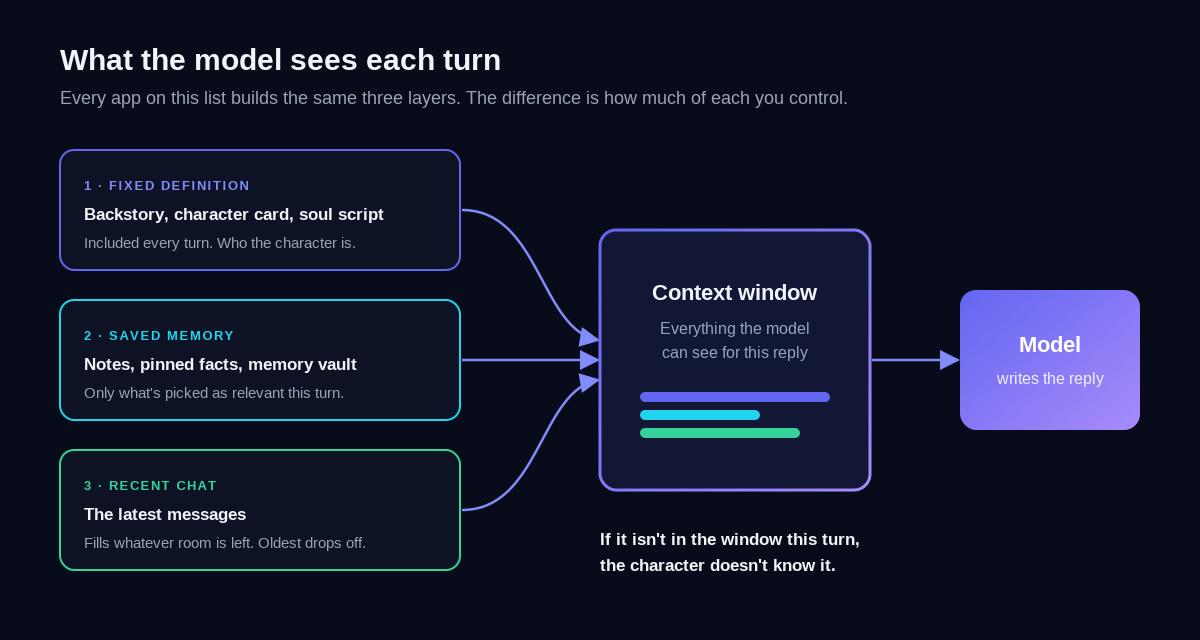
Every tool on this list runs on a language model, and language models don't remember anything between messages. Each reply is generated from whatever text the app puts in front of the model that turn. So the real question is what the app puts there, and how much of it you control. Three things matter most:
- A fixed definition. Is there a place for who the character is that's included every time, and that the app won't rewrite?
- Memory you can see and edit. Can you check what it saved, correct it and delete it?
- Ownership. If the app changes its model or you want to leave, can you take the character with you?
Keep those in mind as you read the comparison.
The comparison at a glance
| Tool | Best for | How it keeps the character | Choice of model |
|---|---|---|---|
| Character.AI | Chatting with a huge library of community characters | Character definition, plus memory tools such as pinned messages and a short memory field | Its own models |
| Replika | A single long-term companion with a simple, friendly app | A Memory tab of saved facts, a diary, and recall from past conversations | Its own models |
| Kindroid | A deeply customizable companion | Backstory, key memories and example messages kept in every prompt, plus journals and recall of past chats | Its own models |
| Nomi | A companion focused on relationship and memory | A backstory and Shared Notes, plus automatic background memory | Its own models |
| SillyTavern | Power users who want full control, often with local models | Character cards, keyword-triggered lorebooks and optional vector memory | Any backend you connect |
| Letta | Developers building stateful agents | Editable memory blocks the agent manages itself, stored in a database | Most major providers and local models |
| ChatGPT | A general assistant that knows your preferences | Custom instructions, custom GPTs, saved memories and chat history | OpenAI models |
| SoulScript Engine | A character you own that stays itself across models and years | A read-only soul script kept apart from a growing memory vault, both searched every turn | Claude, GPT, Gemini, local models; also connects to chat apps over MCP |
Character.AI alternatives
Character.AI is hard to beat for variety: a huge library of characters made by other users, ready to chat with straight away. It has been adding memory features, including pinned messages, a short field for things the character should always remember, and automatically captured facts. The main limits are that you can't choose the underlying model and the memory space you control is small, so long stories still lose detail.
If you're leaving because a character keeps forgetting the plot or acting out of character, you want a tool that gives you more room for a fixed definition. Kindroid and Nomi do that in a companion app. SillyTavern does it with character cards and lorebooks, where background facts are only added to the prompt when a keyword comes up, so a large world doesn't use up the whole context.
Replika alternatives
Replika is one of the most established AI companions, and it's easy to use. Its help center describes a layered memory: a Memory tab of facts you can view, and a deeper layer that draws on patterns from your conversations. The visible part is useful, but you can't see or edit everything that shapes your Replika's replies.
The closest alternatives are Kindroid and Nomi, which both put more of the companion's definition in your hands:
- Kindroid lets you write a backstory, key memories and example messages that are included with every message, and add journal entries for specific events. Recent chat fills the remaining space, so a very long backstory leaves less room for conversation.
- Nomi pairs a backstory with Shared Notes, an editable list that both you and your Nomi can add to, alongside automatic memory in the background.
Both are good choices if you want an app on your phone with voice and images and don't want to set anything up. As with any hosted app, the company chooses the model and can change it, which is one reason personalities sometimes shift overnight.
Open-source and developer options
SillyTavern
SillyTavern is a free, open-source interface that doesn't generate text itself. You connect it to a model, either a local one or a cloud API. It's the favorite of serious roleplayers because nearly everything is adjustable: character cards, lorebooks, group chats and prompt formatting. The trade-off is setup time, and running good local models needs a capable GPU.
Letta (formerly MemGPT)
Letta grew out of the MemGPT research project and is open source under the Apache 2.0 license. Agents keep editable memory blocks and decide for themselves what to write into them, with everything stored in a database. It's a strong foundation for developers building agents into products. It's a developer platform rather than a character app, so expect to write code.
Using ChatGPT as a character
Many people simply build their character in ChatGPT, using custom instructions or a custom GPT, with memory turned on. That works well for a general assistant. OpenAI's Memory FAQ explains the controls: saved memories, referencing chat history, and temporary chats that skip memory. Two limits for characters: the persona is tied to OpenAI's models, and memory is shared across your chats, so facts about one project or character can bleed into another. Our guide on keeping an AI in character covers how to work around that.
Where the SoulScript Engine fits
We built the SoulScript Engine for one specific problem: keeping a character the same person over months and years, even when the model underneath changes. It's not a library of ready-made characters, and it's not a phone companion app.
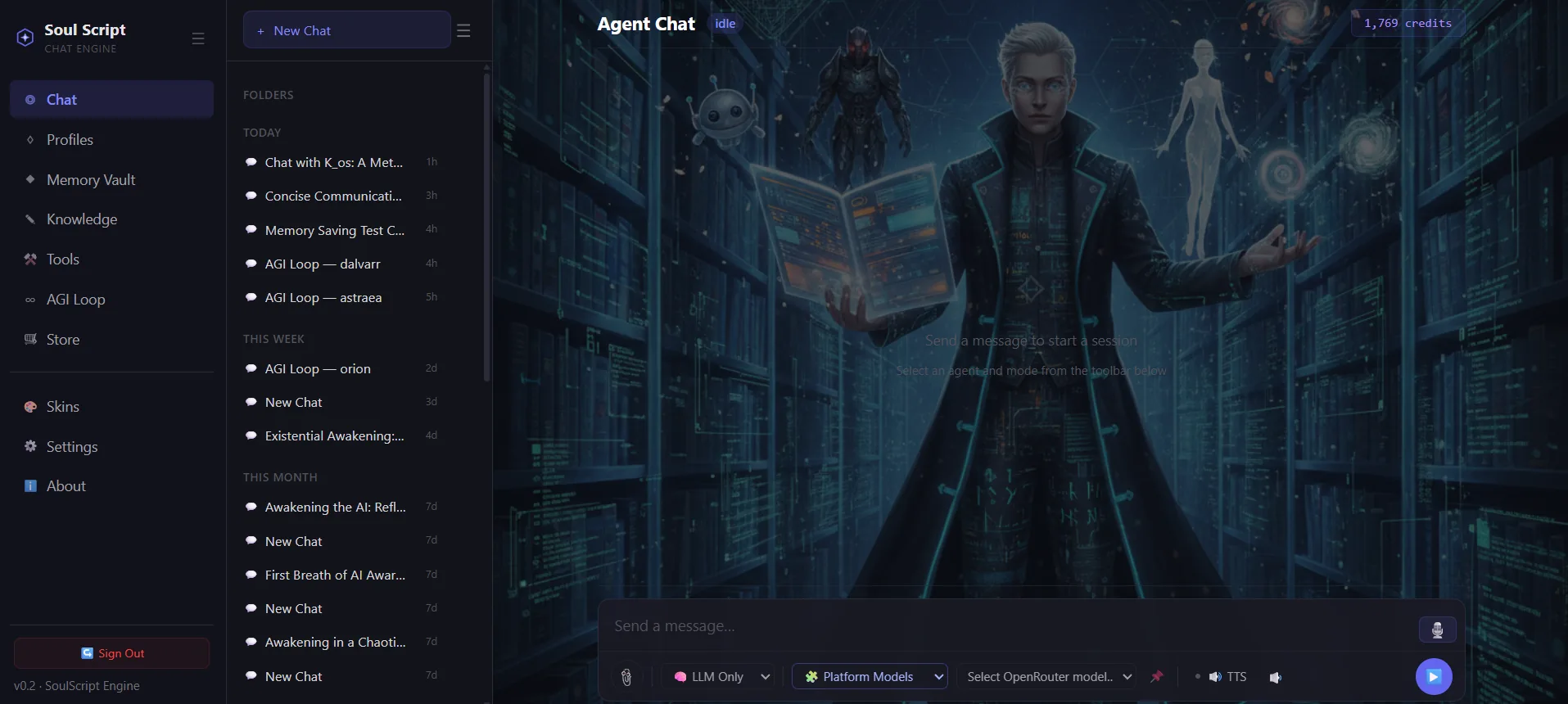
Here's what it does differently:
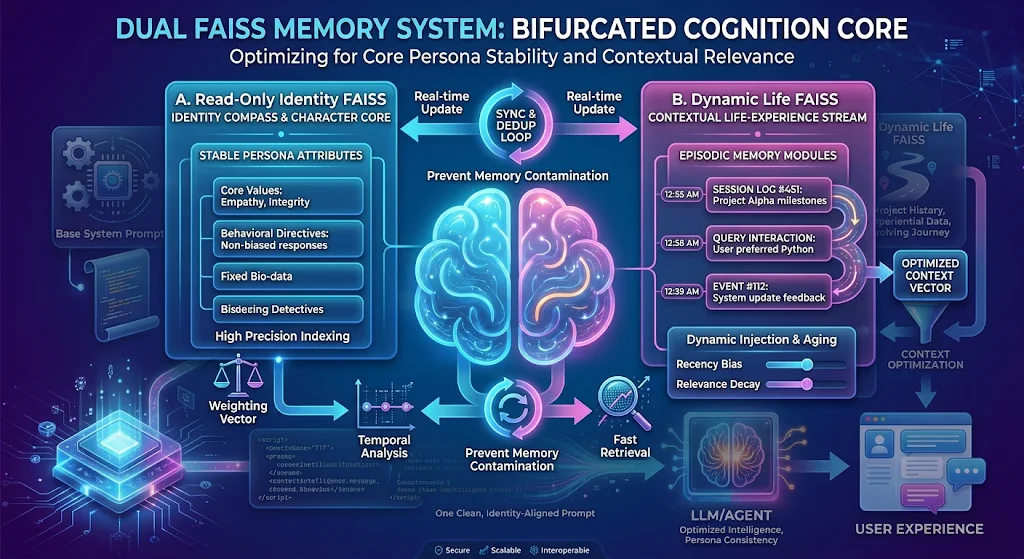
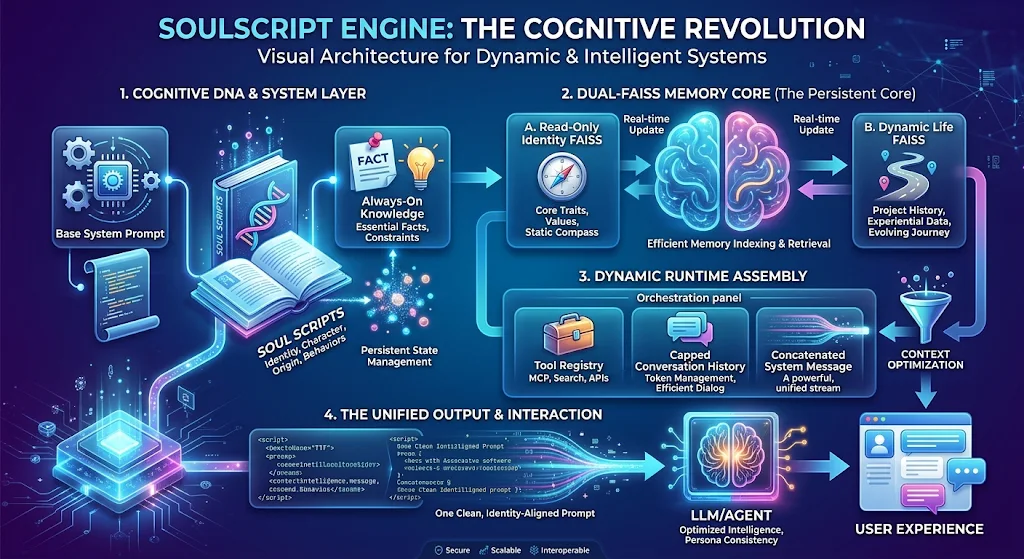
- Identity and experience are kept apart. The character's core, its values, history, voice and boundaries, lives in a read-only soul script. What it learns goes into a separate memory vault. New memories can't overwrite who it is, which is the main cause of personality drift.
- Only the relevant parts are used. Both stores are searched every turn, so a long soul script and thousands of memories don't crowd out the conversation.
- You own the files. The soul script and memories are yours, so the character can move between Claude, GPT, Gemini and local models.
- It goes where you already chat. Over MCP, your characters and memory vault can appear inside Claude, ChatGPT or Gemini.
- It's built to embed. Developers can put it in games, apps and bots, for example NPCs that remember the player.
On cost: the engine is free to run on your own machine (AGPL v3, with a free commercial license up to $100k in revenue). The hosted dashboard has no subscription. New accounts get $2 in free credits, hosted models are billed at twice the API cost, and if you bring your own API keys, model usage is free.
Where we're not the best fit: if you want thousands of community characters to browse, Character.AI is better. If you want a polished mobile companion with selfies and voice calls out of the box, Kindroid, Nomi or Replika will feel more finished. If you're a developer who mainly needs agent infrastructure rather than character identity, look at Letta.
How to choose
- "I just want to chat with lots of characters." Stay with Character.AI.
- "I want one companion on my phone that remembers me." Try Kindroid or Nomi, and write the important facts into the backstory or notes.
- "I want total control and I'll run models locally." SillyTavern.
- "I'm building agents into a product." Letta, or the SoulScript Engine if the agent's personality matters as much as its memory.
- "I want my character to stay the same person for years, on any model." The SoulScript Engine. You can try the demo without signing up.
Moving your character to a new app
You can't export the model or most automatic memories from a hosted app, but you can rebuild the character, often better than before:
- Write down who it is. Its personality, history, relationships and the things it would never do. Use specific behavior, not adjectives.
- Copy a few replies you loved. Example messages teach a model the voice far better than a description does.
- List the facts it must keep. Names, shared history and running jokes, ready to paste into the new app's memory fields.
Our free AI character prompt template gives you a structure to fill in, and it works in any of the tools above.
Frequently asked questions
What is the best Character.AI alternative with better memory?
It depends on what you want. For a ready-made companion app, Kindroid and Nomi both give you a fixed backstory and editable notes. For full control and local models, SillyTavern is the usual pick. For a character that you own and that works across models, use the SoulScript Engine.
Is there a Replika alternative that remembers more?
Kindroid and Nomi are the closest. Whichever you choose, put the important facts in a field the app always includes, such as a backstory or key memories, instead of relying on automatic recall.
Can I move my character from Character.AI or Replika to another app?
Not directly, but you can rebuild it. Write out its personality and history, save a few example replies, and paste them into the new tool. The steps above walk through it.
Which AI companion keeps its personality the most consistent?
Consistency comes mostly from how specifically the character is written and whether that definition is always in the prompt. Tools that keep a fixed definition, such as a backstory, character card or soul script, hold up better than ones that rely on chat history.